-
BECMI Berserker
A great series of videos on BECMI and BECMI-adjacent content can be found on YouTube at BECMI Berserker’s channel.
BECMI Berserk goes over in-depth looks into BECMI rules, reviews of BECMI modules, and overviews of the many gazetteers describing the “Known World.”
I enjoy the quality of his videos include not only the information but also the presentation and production quality. If you spend time on YouTube, I highly recommend BECMI Berserker’s channel.
-
Frank Mentzer’s Temporal Studios
If you love BECMI, then you know its author, Frank Mentzer.
Mr. Mentzer has started up a new company called Temporal Studios. You can follow Temporal Studios and Frank Mentzer on Facebook to watch the progress with the new company getting ready to work on new products. Rumor has it that a better and much more in-depth introduction to the Immortals system from BECMI is under consideration. *fingers crossed*
The official Temporal Studios website is still pretty basic, but worth watching as the new company gets up and going.
-
Dude. Where’s my Old D&D?
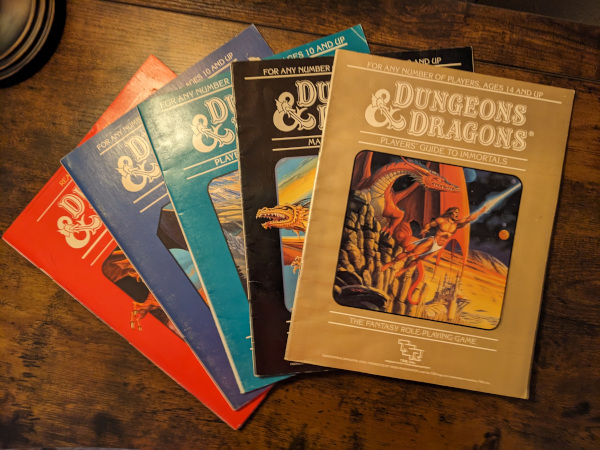
BECMI also known as Basic, Expert, Companion, Masters, Immortals rules Millions of us played Dungeons and Dragons (aka D&D) in the 1970s and 1980s. We got busy with life, and are just barely finding time near or in retirement to get back to our favorite teenage hobby.
Still more millions of us grew up looking at our parent(s) old D&D books or even playing games as family time with the old rules and want to find out where they all went. It’s nostalgia, or maybe we’re looking for something a bit simpler than the newer versions of D&D or Pathfinder role-playing games.
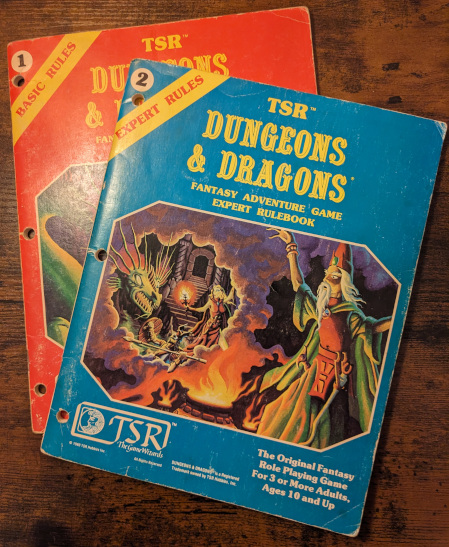
B/X or Basic / Expert consisted of just the Basic and Expert rules, but mention a Companion rules book that never joined this edition. Looking Back
The old TSR company that produced D&D from the 1970s and 1980s is gone. It got sold out to Wizards of the Coast (WotC) in the 1990s. Then WotC got absorbed by the game-play black hole known as Hasbro.
For decades, the only way you could get a hold of the old rules was through Ebay or other online flee markets. Eventually, Hasbro kindly made the old rules and adventures available as PDFs for sale online.
In the mean time, the older versions of the game developed a new online presence and tag-line. The old versions of the game became known as OSR. OSR stands for Old School R*@#$. (No one really agrees on what the ‘R’ stands for. Renaissance, Revival, or pick your favorite ‘R’ word.
Those that lived through the 1970s and 1980s probably experienced the fluidity of the adventures and rules. Many people playing the game back then felt AD&D was different from D&D, but players of D&D rarely cared about the differences in editions of D&D. You would often see different editions of D&D rules at the same tables even though a close examination would have shown stats didn’t match up between different editions of D&D. This lack of concern about the differences in those early editions of D&D likely led to them all being clumped together under the single title of OSR.
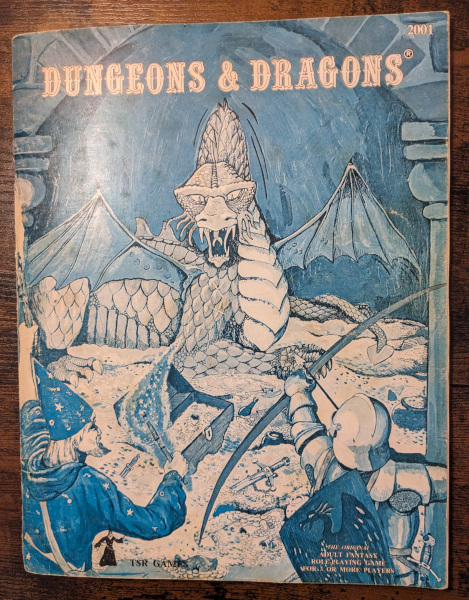
Versions of D&D before the B/X version are often clumped under the designation of Original D&D. OSR Clone Wars
The three sets of old D&D rules that primarily were included in the OSR definition were:
- Original D&D that included any of the editions that came before the first Expert Rules were written.
- B/X D&D which included the era of the first Basic and Expert box sets.
- BECMI D&D that came out in the 1980s and included box sets for Basic, Expert, Companion, Masters, and Immortals rules.
For some reason, there wasn’t as much strong nostalgia for AD&D. Possibly, the types of players that wanted the most complex version of D&D love the modern crunchy complexity found in 5th edition D&D and beyond.
All the renewed excitement about the old versions of D&D in the new millennium (post 1999) resulted in a bunch of OSR-compatible games and adventures being produced. Several clones of the OSR rules came about in the 2010s.
Some of the most popular OSR-compatible rules sets that came out include Old-School Essentials, Dungeon Crawl Classics, Shadowdark, and Cairn. There are tons more.
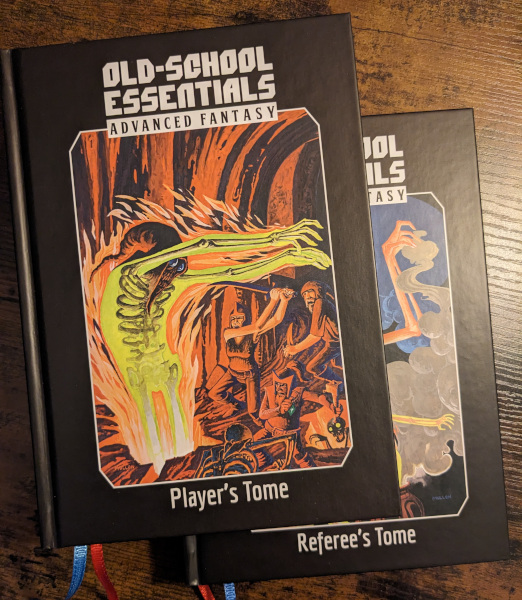
OSE or Old-School Essentials currently holds the top spot for B/X compatible games. Old-School Essentials
Probably the most popular of the OSR rules sets is Old-School Essentials (OSE).
The first version of version of OSE was pretty much a clone of B/X D&D with a much better presentation and organization. Then an add-on to that classic OSE came out that incorporated some of the favorite classes and rules into OSE. Imagine if AD&D had been converted to be compatible with B/X D&D and you’d have a pretty good idea what the additions were like.
After all the extra books those additions created, the creators of OSE came out with an “Advanced Fantasy” OSE. This kept the simplicity of B/X rules, but gave options from AD&D converted to be compatible with OSR D&D. That two-tome rule set has proved to be the most popular of the ORE and possibly OSR-style role-playing games.
Dude. Where’s my D&D?
You have lots of really good options. The two best options are, find the original rules and adventures as PDFs on sites like DriveThruRPG. The other really good option is to pick up the two Old-School Essentials Advanced Fantasy rules tomes: Players Tome and Referees Tome.
However, you’ll probably find that any OSR compatible rules set will easily work with your old adventures or new OSR-compatible adventures with minimal conversion.
-
Solo BECMI
Everything is playing, even if it’s just trying to find a system or generating a character and moving on.
-Geek Gamers, Solo Game Master’s GuideI’m working on an online character sheet for BECMI. It will save to the web browser’s cache, so be careful not to delete your cache, or at least print out your saved character to make sure you don’t lose your stats if you do clear your cache. I’ll add the link to this post when I have the page available.
UPDATE: BECMI Character Sheets
That link will take you to the BECMI Character Sheets page. You can store multiple characters in the browser cache and switch between them quickly. If you want to back up an important character, create a PDF out of it with the button at the bottom.
-
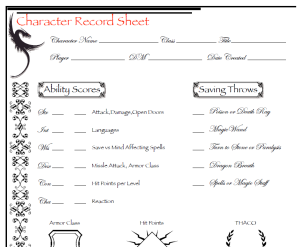
BECMI D&D Character Sheet
I threw this Character Sheet together around 20 years ago. Now that I have time to get back into Role-playing, I’ve tracked it down. Feel free to copy it and pass it around.
becmi_character_record_sheet_v2
-
BECMI D&D
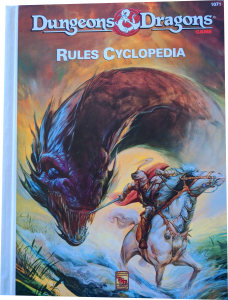 BECMI D&D took center stage in the TSR universe with the publication of the red Basic box set in 1983. The Basic Dungeons and Dragons box set was followed up by the Expert, Companion, Masters, and Immortals box sets. Thus the name BECMI D&D. However, it took decades before people started referring to that series of box sets as BECMI. Those of us that played it at the time simply referred to it as D&D, as opposed to the unnecessarily complex AD&D.
TSR ended its support of BECMI D&D in or around 1994-1995, with the end of its support for Mystara (the BECMI realm) in 1995. During that time, many rulebooks, adventures (modules), and supplements were published. Also, three magazines (Dragon, Polyhedron, and Dungeon) occasionally featured articles or adventures for BECMI D&D under the name of “D&D”.
Adventures and articles for AD&D could also be adapted for D&D. It took some guess work to do the conversions. Most of us players and dungeon masters of D&D would not take on the effort to convert AD&D to D&D.
Most players of BECMI D&D adopted the adventures and supplements from the older BX D&D and even older original D&D. We mostly considered BX D&D to be the same game as our favored D&D, just slightly outdated. So many Basic and Expert D&D modules and supplements from 1981 and before were adopted by BECMI D&D enthusiasts. Commonly, you’d see BX rulebooks at the same table as BECMI rulebooks during sessions. No one thought that was strange.
-
Start Playing Profile
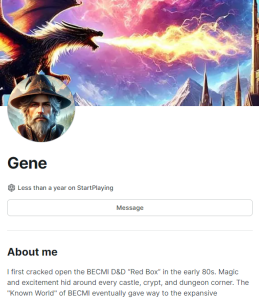 I’m moving closer to hosting some BECMI D&D and Pathfinder 2e Remaster games. I’m planning to host some private one-shots over the next month or two, and depending on how that goes, I’ll decide if the time is right for listing a game or two on Start Playing.
Here is my “About Me” profile from Start Playing.
About me
I first cracked open the BECMI D&D “Red Box” in the early 80s. Magic and excitement hid around every castle, crypt, and dungeon corner. The “Known World” of BECMI eventually gave way to the expansive “Golarion” of Pathfinder 2e Remaster and the endless universe of Starfinder Second Edition.
I love teaching new players the thrill of RPGs, and keep the atmosphere playful, respectful, and comfortably PG. I ask players to do the same. Expect moments of meta-humor, a dash of the “rule of cool,” and an occasional behind-the-screen dice “adjustment” to keep the adventure exciting.
New to BECMI D&D or Pathfinder? No problem! I walk you through character creation, rules, and table etiquette—so you can jump right into the adventure without feeling overwhelmed.
-
Fate of the D&D R-series
Editor’s note: I ran into a reference to the R-series being created for D&D back in 1982, but knew that BECMI never had an R-series. I asked ChatGPT to research it for me. The following is the result of that research. Remember to check all sources, because LLMs often hallucinate and give made up information. The rest of this article is from ChatGPT’s research.
I’ll dig into whether the ‘R’ series of modules for higher-level D&D players, mentioned in The Polyhedron #005 from around 1982, were ever officially published or developed by Gary Gygax for the RPGA. I’ll also look for any information on unpublished drafts, playtest materials, or whether these ideas evolved into other known modules. I’ll update you with my findings soon.
The RPGA “R” Series Modules – Plans, Publications, and Fate
Origins and Plans for the “R” Series in 1982
In early 1982, TSR’s RPGA (Role-Playing Gamers Association) announced a special series of AD&D modules, code-named the “R” series, intended for experienced or higher-level players. In Polyhedron #5 (April 1982), RPGA coordinator Frank Mentzer (with Gary Gygax’s oversight) revealed that two new tournament scenarios from Gen Con South 1982 would be released to RPGA members as modules R-5 and R-6 by that fall (Full text of “Dungeons & Dragons World – Magazines – Polyhedron Magazine”). This was part of a broader plan by Mentzer – who founded the RPGA under Gygax’s guidance – to create a whole lineup of exclusive RPGA modules. Gygax and Mentzer envisioned using the R-series to expand the World of Greyhawk setting with a new continent (Mentzer’s home campaign world of “Aquaria”). In fact, Mentzer initially intended the R-series adventures to take place on a distant Greyhawk continent called Aquaria (or “Aqua-Oeridian”), potentially forming the basis of a new Greyhawk boxed set (List of Dungeons & Dragons modules – Wikipedia) (Frank Mentzer | Dungeons and Dragons Wiki | Fandom). This ambitious plan had the blessing of Gygax at the time, but it was only partially realized. (more…)